
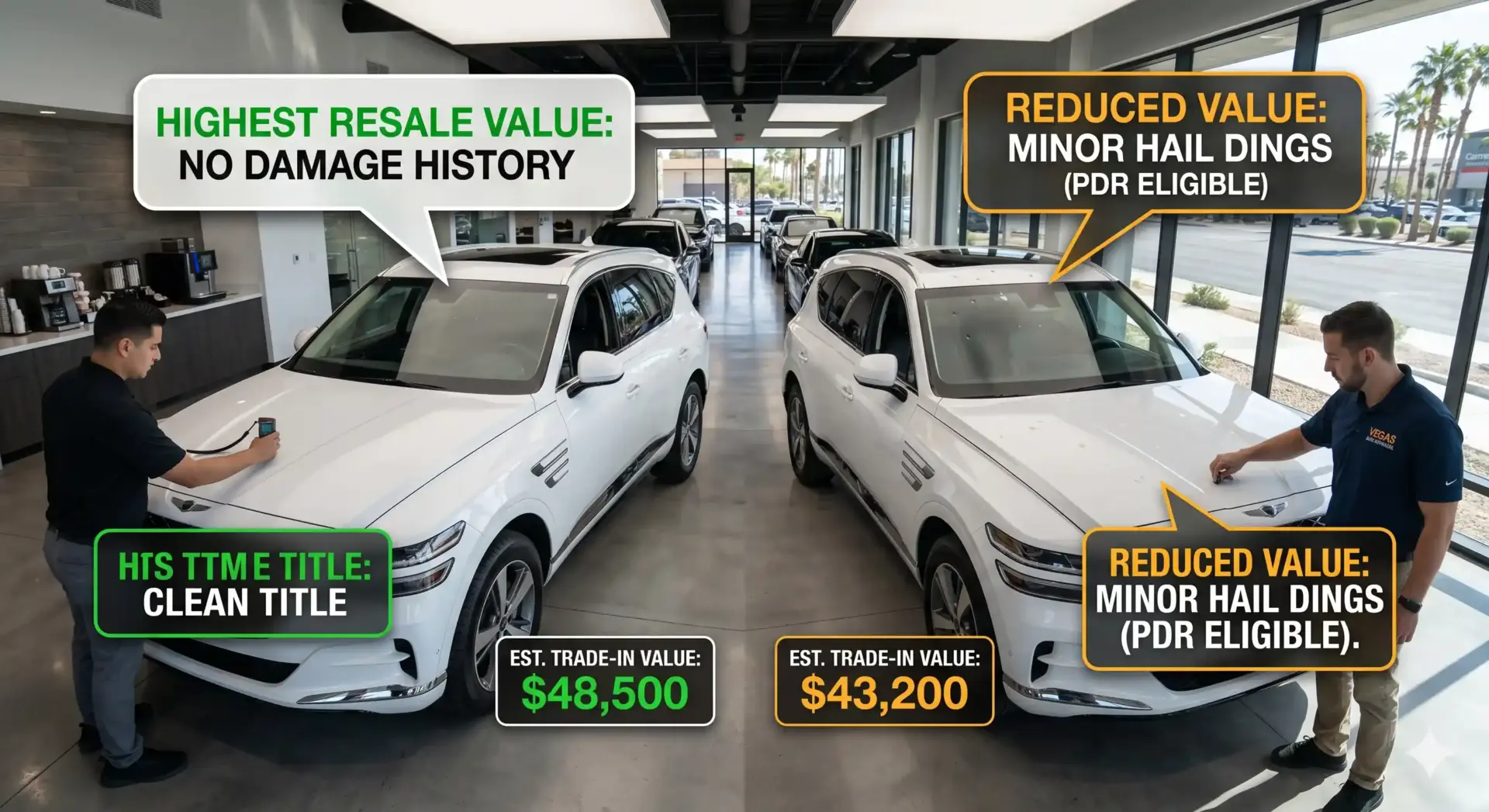
A single hailstorm can do more than dent your hood — it can quietly drain thousands of dollars from your car’s resale value before you ever step onto a dealership lot. In 2026, with used car prices stabilizing and trade-in appraisals increasingly powered by AI-driven tools, buyers and dealers scrutinize vehicle history more closely than ever. Even repairs that look flawless on the surface can trigger flags that cost you at the negotiating table.
Whether you’re planning to sell, trade in, or return a lease, understanding how hail damage and car resale value interact is one of the smartest financial moves you can make. Here’s exactly what you need to know.
The Financial Impact: How Much Value Do You Actually Lose?
The dollar figure depends heavily on one key decision: whether you repair the damage or leave it as-is. Both paths carry a financial cost — they’re just different kinds of losses.
Unrepaired Damage: The “Double Loss”
Leaving hail damage unrepaired is the most expensive mistake a car owner can make before selling. You don’t just absorb the visible dent count — you absorb a buyer hesitation penalty on top of it.
Dealers and private buyers both apply a mental multiplier to unrepaired damage. A moderately hail-damaged vehicle requires them to factor in their own repair costs, the time the car sits off the lot, and the uncertainty of hidden damage beneath the surface. As a result, dealers typically deduct 1.5 times the actual repair cost from a trade-in offer to account for their risk. On a car with $3,000 in hail repairs needed, that could mean a $4,500 to $5,000 reduction in your offer.
On average, unrepaired hail damage reduces a car’s resale value by $2,500 to $5,000, or roughly 15–20% of its Actual Cash Value (ACV).
Repaired Damage: The “Diminished Value” Concept
Even after professional repairs, your car’s value will be lower than a comparable vehicle with a clean history. This is called inherent diminished value — the permanent stigma a vehicle carries once it has a documented repair history, regardless of how well it was fixed.
The concept is straightforward: two identical vehicles with identical mileage, one with a clean history and one with a “Hail Damage Repaired” notation, will not command the same price. Buyers know the repaired vehicle may have issues that aren’t visible, and they price accordingly.
The good news is that the type of repair makes a significant difference. Paintless Dent Repair (PDR), which preserves your vehicle’s original factory paint, results in far less diminished value than traditional bodywork that requires repainting panels.
2026 Resale Value Impact Table
The table below reflects estimated value reductions based on damage severity and repair method in the current market:
| Damage Severity | Estimated Value Drop (Unrepaired) | Estimated Value Drop (Repaired via PDR) |
| Minor (10–20 dings) | 10% – 15% | 2% – 5% |
| Moderate (Multi-panel) | 20% – 25% | 5% – 10% |
| Severe (Broken glass/paint damage) | 30% – 50%+ | 15% – 20% |
The difference between “unrepaired” and “repaired via PDR” is stark at every level of severity. For a vehicle valued at $35,000, moderate unrepaired damage could cost you $7,000–$8,750 at trade-in. The same damage repaired professionally via PDR might only cost you $1,750–$3,500 — a difference of $5,000 or more on a single transaction.
PDR vs. Traditional Body Work: Which Protects Value Better?
Not all repairs are created equal when it comes to preserving resale value. The method used to fix hail damage has a direct impact on how appraisers — and the AI tools they increasingly rely on — evaluate your vehicle.
The Power of Factory Paint
In 2026, buyers and appraisers place significant weight on whether a vehicle retains its original factory paint. Factory paint is applied in a controlled environment with materials and processes that independent body shops cannot replicate exactly. When a panel is repainted after hail repair, trained appraisers — and modern scanning tools — can detect color inconsistencies, texture differences, and paint thickness variations that signal non-factory work.
This triggers a “repainted panel” flag that can further reduce your vehicle’s value beyond the basic damage notation. Paintless Dent Repair (PDR) sidesteps this problem entirely. By working the metal back to its original shape from behind the panel, PDR leaves the factory paint completely intact. No repainting. No mismatched panels. No flags on the appraisal report.
Avoiding the “Totaled” Label
Beyond diminished value, the cost of repairs relative to your vehicle’s worth determines whether your car gets classified as a total loss. In 2026, most states apply a total loss threshold of 70–75%: if repair costs exceed that percentage of the car’s Actual Cash Value, the vehicle is declared a total loss and issued a Salvage or Rebuilt title.
A Salvage title is one of the most damaging labels a vehicle can carry. It can reduce resale value by 20–40% permanently and makes the car nearly impossible to finance through traditional lenders. Because PDR costs significantly less than traditional body shop repairs, it keeps far more vehicles under the total loss threshold — protecting owners from the worst-case resale scenario.
Does Hail Damage Show Up on Carfax in 2026?
This is one of the most common questions car owners ask after a hailstorm, and the answer is: it depends on whether you filed an insurance claim.
When you file a comprehensive insurance claim for hail damage, the claim is typically reported to vehicle history databases including Carfax and AutoCheck. However, the specific language of the notation matters enormously to future buyers. A record showing “Hail Damage Repaired” reads very differently from “Accident/Collision Damage” in the eyes of a buyer or dealer. The former signals a weather event with a clean repair; the latter raises questions about structural integrity and safety systems.
If you use a high-quality PDR repair service and have documentation — invoices, before-and-after photos, warranty paperwork — you can proactively present that history to buyers. A well-documented PDR repair by a reputable shop can significantly mitigate the Carfax impact, reassuring buyers that the repair was non-invasive and that factory paint was preserved.
If you opt not to file an insurance claim and pay for repairs out of pocket, the damage may not appear on the vehicle history report at all — though appraisers using physical inspection and AI scanning tools may still detect prior damage evidence.
How to Recover Your Loss: Diminished Value Claims
Here’s something many car owners don’t know: even after your insurer pays to repair the physical damage, you may be entitled to file a separate diminished value claim to recover the market value your vehicle lost as a result of the incident.
Diminished value claims are particularly relevant in at-fault accident scenarios, but some insurers will consider them for hail events as well. The process generally involves:
- Getting a third-party appraisal that documents your vehicle’s pre-storm value versus its current post-repair market value.
- Submitting that appraisal to your insurance company along with a formal diminished value claim.
- Negotiating a settlement, which may require persistence — insurers don’t always approve these voluntarily.
State laws vary considerably on whether and how diminished value claims can be filed, so it’s worth reviewing your policy language and consulting a local resource if you believe your vehicle’s value took a significant hit. Even a partial settlement can meaningfully offset what you’ll lose at trade-in.
Conclusion: Making the Smart Move Before You Sell
When it comes to hail damage and car resale value, the math almost always points in the same direction: get the damage repaired professionally before you sell, and choose a repair method that protects your factory paint. Leaving damage unrepaired is rarely the financially savvy choice — it simply transfers the cost to you at the worst possible moment, when you’re already in a weaker negotiating position.
The most value-preserving path for most hail damage scenarios is high-quality PDR performed by experienced technicians who can restore your vehicle without touching the paint. Pair that with thorough documentation and, if applicable, a diminished value claim, and you’ve done everything in your power to protect your investment.
Before your next sale or trade-in, consider scheduling a Resale Value Preservation Inspection with the Hail-Tech PDR team. We’ll assess your vehicle’s condition, walk you through your repair options, and make sure you’re putting your best car forward when it counts. Request a quote online or call us at 512-817-6357 — we’re here Monday through Friday, 8:00 AM to 5:00 PM.
Frequently Asked Questions
How much does hail damage devalue a car? On average, unrepaired hail damage reduces a car’s resale value by $2,500 to $5,000, which works out to roughly 15–20% of its Actual Cash Value (ACV). The exact figure depends on the severity of the damage, the vehicle’s make and model, and current market conditions. Repairing the damage via PDR can reduce that loss to as little as 2–5% for minor damage.
Is it better to trade in a car with hail damage or fix it first? In most cases, it’s better to repair the damage using your insurance claim before trading in. Dealers frequently deduct 1.5 times the actual repair cost from trade-in offers to account for their own risk and the time the vehicle will sit off the lot. Repairing first puts you in a much stronger negotiating position and typically yields a net financial gain even after your deductible.
Can I sell a car with a “Hail Damage” report on Carfax? Yes — a Carfax notation doesn’t prevent a sale. However, expect buyers to discount the vehicle by 5–10% compared to a clean-history car. Providing documentation of high-quality PDR repairs, including invoices and warranty paperwork, can help reduce that discount by giving buyers confidence in the quality of the fix.
Does hail damage total a car? It can. In 2026, most states apply a total loss threshold of 70–75%, meaning if repair costs exceed that percentage of the vehicle’s Actual Cash Value, it’s declared a total loss. This results in a Salvage or Rebuilt title, which can reduce future resale value by 20–40% and complicates financing. Choosing PDR, which costs significantly less than traditional body shop work, is one of the best ways to keep your vehicle under the total loss threshold.
What is “inherent diminished value” after hail damage? Inherent diminished value is the permanent reduction in a vehicle’s market price that occurs simply because it has a documented repair history — even after a perfect, invisible repair. Buyers perceive a repaired vehicle as carrying more risk than a clean-history equivalent, and they price accordingly. Minimizing this loss starts with choosing a repair method, like PDR, that leaves no visible trace and preserves factory paint.
How does the type of repair affect my car’s resale value? PDR-based repairs consistently outperform traditional bodywork when it comes to protecting resale value. Because PDR preserves the vehicle’s original factory paint and requires no repainting, there are no mismatched panels, no paint thickness irregularities, and no “repainted panel” flags on modern AI-driven appraisals. Traditional body shop repairs that involve repainting can trigger additional value deductions even when the repair itself is high quality.