
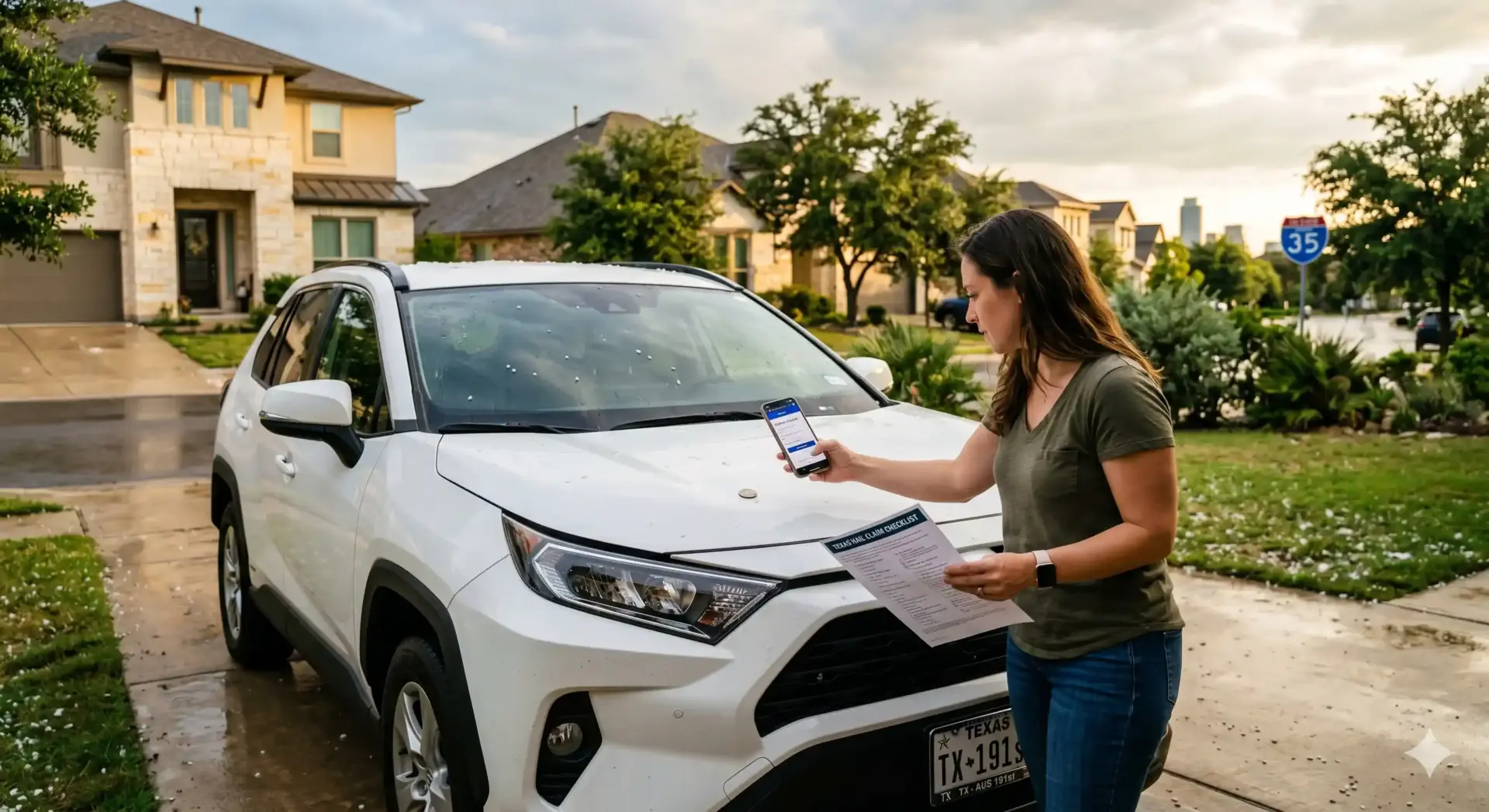
Texas is the number one state in the country for hail damage, and if you’ve ever had your car caught in a storm — whether on I-35 near UT Austin campus or parked outside your home in Round Rock — you already know the sinking feeling of walking out to a hood full of dents. The good news is that if you carry comprehensive coverage, your insurance policy likely covers the damage. The bad news is that the claims process has become more complex in 2026, with new digital filing requirements, percentage-based deductibles, and stricter reporting windows introduced under Texas House Bill 2067.
Filing sooner rather than later is now the gold standard for Texas hail claims. Delays open the door for insurers to dispute damage as “pre-existing,” and under the new law, failing to provide “prompt notice” can complicate or even jeopardize your payout. This guide walks you through every step of the hail damage insurance claim process, from the moment the storm clears to the day you pick up your repaired vehicle — with Texas-specific details and 2026 updates built in.
Step 1: Immediate Damage Documentation
The moments right after a hailstorm are the most valuable time you have. Your job isn’t to start making calls yet — it’s to build an ironclad visual record of what the storm did to your vehicle before anything changes.
The 24-Hour Rule: Why Speed Improves Your Payout in Austin
In the current Texas insurance environment, reporting within 24 hours of a storm event dramatically improves both approval timelines and settlement outcomes. Adjusters can cross-reference your claim date against official NOAA storm data, which makes timing easy to verify. A report filed the same day eliminates virtually all ambiguity about whether the damage was storm-caused. For Austin drivers in particular — where hail seasons run from March through June and storms can hit multiple zip codes in a single afternoon — fast reporting also reduces the backlog of claims you’re competing with for adjuster availability.
💡 Pro Tip: Screenshot your NOAA Weather Alerts app immediately after the storm. That timestamp serves as independent proof of the date and severity of the weather event — something insurers cannot dispute.
Photo & Video Standards That Hold Up in a Claim
Not all documentation is created equal. Insurers have seen every kind of blurry, poorly-lit photo, and weak documentation gives adjusters room to undervalue your claim. Follow these standards to produce timestamped photos that are claim-ready:
- Use natural light or a consistent flash — never photograph in harsh afternoon glare that washes out dent shadows.
- Place a quarter or golf ball next to each dent for scale. Adjusters need size reference to classify damage severity.
- Capture 360-degree views of the vehicle: all four panels, the roof, hood, trunk, and any glass damage.
- Shoot video in addition to stills. A slow walk-around with narration (“This is the driver’s-side door, you can see approximately 15 dents…”) creates powerful supporting evidence.
- Enable your phone’s metadata embedding so every photo carries a GPS location and exact timestamp.
Step 2: Review Your Texas Policy Coverage
Before you call your insurer, spend five minutes with your policy declarations page. Knowing your coverage type and deductible amount upfront puts you in a much stronger negotiating position and prevents surprises when the adjuster’s estimate arrives.
Comprehensive vs. Collision: The Coverage You Must Have
Hail damage is covered under comprehensive coverage — not collision. Comprehensive covers damage caused by weather events, falling objects, theft, and other non-collision incidents. If you only carry liability and collision coverage on your policy, hail damage is not covered, and you will be paying for repairs entirely out of pocket. This is one of the most common and costly misconceptions Texas drivers encounter after a storm. If you’re unsure of your coverage type, check your declarations page or call your agent before filing.
Understanding 2026 Deductibles in Texas
The shift toward percentage-based deductibles has accelerated significantly in 2026. Rather than a flat amount (say, $500 or $1,000), many Texas policies now apply a deductible calculated as a percentage of your vehicle’s actual cash value (ACV). For example, if your car is valued at $22,000 and your deductible is 2%, you’re responsible for the first $440 of any claim. On a higher-value vehicle, this can mean a substantially larger out-of-pocket cost than you might expect.
Check your declarations page carefully for the phrase “comprehensive deductible” or “hail deductible.” Some policies now separate these. Understanding your actual out-of-pocket exposure before you file helps you determine whether filing is financially worthwhile and prepares you for the settlement math.
💡 Pro Tip: If your repair estimate is only slightly above your deductible, weigh carefully whether filing makes sense. A filed claim — even a weather claim — appears in your CLUE report and could affect future insurability with certain carriers.
Step 3: Initiating the Claim (The Digital Shift)
Filing a hail damage insurance claim in Texas has moved almost entirely online in 2026. Most major carriers — including State Farm, USAA, Allstate, and Farmers — now handle first notice of loss (FNOL) through their mobile app or digital portal. Phone claims are still available but may take longer to process.
Using Your Carrier’s App to Speed Up Virtual Adjustment
When you upload your timestamped photos and video documentation directly through your carrier’s app, you trigger the virtual adjustment process. Many insurers now use AI-assisted photo analysis to produce an initial repair estimate within hours of submission — sometimes before a human adjuster reviews the file. This process is faster and often results in quicker payout timelines, but the quality of your documentation directly determines the accuracy of the initial estimate. Weak photos can produce an undervalued estimate that requires a supplement request later.
Your Claim Number: The Most Important Number You’ll Get
Once your claim is filed, your insurer will issue a claim number. Write this down immediately and keep it accessible. Every phone call you make, every email you send, every supplement request you submit — everything ties back to this number. Without it, customer service representatives cannot locate your file, and delays compound quickly. Store it in your phone notes, photograph the confirmation screen, and email it to yourself.
Step 4: The Inspection & Adjustment
After your initial claim submission, your insurer will either send an Austin claim adjuster to inspect the vehicle in person or rely on your uploaded documentation for a virtual inspection. Either way, this step determines the repair estimate you’ll work from.
What to Do If the Initial Estimate Feels Low
Low initial estimates are common in hail claims, particularly when damage is assessed virtually. If the insurer’s estimate doesn’t match what your repair shop identifies, you are entitled to request a supplement. Here’s how the process works:
- Take your vehicle to a qualified repair facility for their own damage assessment.
- If their estimate is higher than the insurer’s, the shop submits a supplement request directly to your carrier with supporting documentation.
- The insurer reviews the supplement and issues a revised estimate or a supplemental payment.
- If there is still a dispute, Texas law allows you to invoke appraisal or hire a licensed public adjuster to advocate on your behalf.
A reputable repair facility experienced with insurance claims will manage this supplement process for you, making it far less stressful than navigating it alone.
Your Legal Right to Choose Your Own Texas Repair Shop
Under Texas law, you have the absolute right to choose the repair facility that works on your vehicle. Your insurer may suggest or recommend shops within their “DRP” (direct repair program) network, and those recommendations can be genuine — but they are never mandatory. If a carrier representative implies you must use a specific shop, this is incorrect and worth pushing back on. Choose a shop that has a strong track record, uses qualified technicians, and ideally carries NATE-certified expertise in paintless dent repair for hail damage.
For Austin drivers, professional hail damage repair with paintless dent repair (PDR) is almost always the most cost-effective and fastest approach for storm damage. PDR preserves your factory paint finish, protects your vehicle’s resale value, and eliminates the delays that come with traditional bodywork and repainting.
Step 5: Finalizing Repairs & Payout
Once the adjuster’s estimate is finalized (including any approved supplements), the repair process can begin. But before you hand over your keys, make sure you understand how payment will work.
Direct Pay vs. Two-Party Checks: What You Need to Know
If you own your vehicle outright, the insurer will typically issue a check directly to you or, in some cases, directly to the repair shop. If your car is financed or leased, the lender or lessor is typically listed as a co-payee on the insurance check — meaning the check will be made out to both you and your financial institution. You will need to get the lender’s endorsement before the funds can be applied to repairs.
This two-party check process surprises many drivers. Contact your lender early in the process to understand their endorsement procedure. Some lenders can process endorsements quickly; others require the vehicle to be inspected after repair before releasing funds. Knowing this ahead of time prevents repair delays.
💡 Pro Tip: Your repair shop deals with two-party checks regularly. Ask them upfront how they prefer to handle lender-endorsed checks — a good shop will walk you through the process and may even coordinate with your lender directly.
Important: Texas Statute of Limitations for Hail Claims
Under Texas law, you have two years from the date of the storm to file a hail damage insurance claim. This is the legal statute of limitations, and once it passes, your right to file is permanently extinguished — regardless of how severe the damage is or what your policy says.
That said, two years is the legal floor, not a target. Most policies also include a “prompt notice” clause requiring you to report damage “in a reasonable time.” Filing within 30 days is the strongly recommended standard for Texas drivers. Waiting longer invites disputes over rust formation, pre-existing dents, and deteriorating damage — all of which give adjusters grounds to reduce or deny your payout. The hail damage insurance claim process runs most smoothly when initiated quickly.
Navigating Texas Hail Season with Confidence
Texas hail season is an annual reality, but a dented car doesn’t have to mean a painful claims experience. The drivers who come out of it fastest and with the best results are the ones who document immediately, understand their deductible, file promptly through the digital portal, and exercise their right to choose a trusted repair shop.
At Hail-Tech PDR in Austin, we’ve helped hundreds of local drivers navigate the car hail damage insurance claim process from start to finish. We work directly with all major insurance providers, assist with supplement requests, and deliver precision paintless dent repair that restores your vehicle without touching your factory finish. If your car was caught in a recent Austin storm, don’t wait — reach out to our team today for a free inspection and claims guidance.
📞 Call us at 512-817-6357 or request a free estimate online.
Frequently Asked Questions
Will my insurance rates go up if I file a hail claim in Texas?
In most cases, no. Texas insurers classify hail as an “Act of God,” and individual weather-related claims typically do not trigger premium increases at the policy level. However, statewide rate hikes can occur after high-frequency storm years as carriers adjust their overall risk models. Filing a hail claim in isolation is generally not a reason to avoid reporting damage.
How long do I have to file a hail claim in Texas?
The legal statute of limitations for hail damage insurance claims in Texas is two years from the date of the storm. However, most policies also require “prompt notice,” and filing within 30 days is strongly recommended to prevent disputes over rust, pre-existing damage, or deterioration. Don’t mistake the two-year legal window for a comfortable waiting period.
Does Texas have a “total loss” threshold for hail?
Yes. In Texas, a vehicle is generally considered a total loss when estimated repair costs exceed 70–75% of the car’s actual cash value (ACV). If your insurer determines the vehicle is a total loss, they will offer you a settlement based on the ACV rather than paying for repairs. You can negotiate this amount if you believe the ACV calculation is too low.
Can I keep the insurance money and not fix the hail damage?
If you own the vehicle outright, yes — you are not legally required to use the insurance payout for repairs. However, be aware that your insurer will note the unrepaired damage and will typically exclude hail damage from future coverage until you provide proof of repair. Additionally, unrepaired hail damage significantly reduces your vehicle’s resale value.
What is the difference between ACV and replacement cost in a Texas hail claim?
Actual cash value (ACV) is the market value of your vehicle at the time of the damage, accounting for depreciation. Most standard Texas auto policies pay out at ACV for comprehensive claims. Replacement cost coverage pays what it would cost to replace the vehicle with a comparable model without depreciation deductions — it’s less common on auto policies than on homeowners policies. Review your policy to understand which applies to your hail claim.